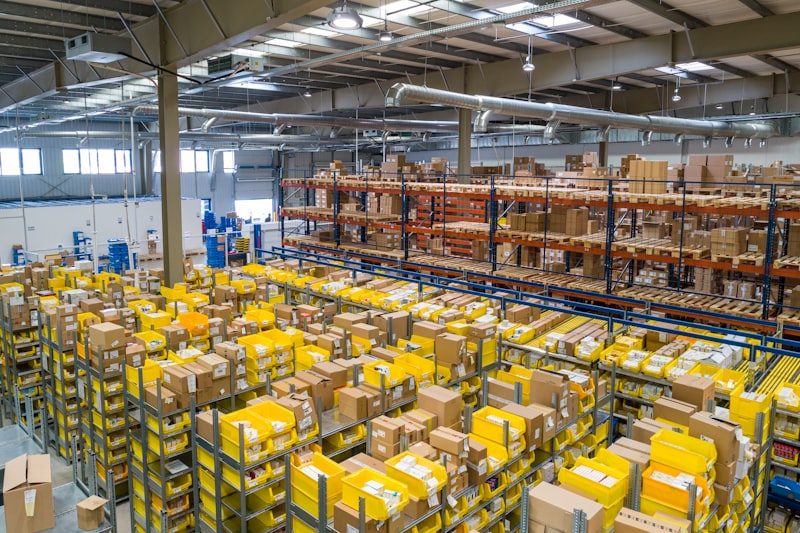
There is a question that separates retail and wholesale businesses into two groups. How much of item 4471 do you have right now? The first group looks it up and tells you. The second group tells you what the system says, then explains why the system is wrong, then offers to go and count it.
Almost every problem in a stock-holding business traces back to that second answer. If the stock figure is a matter of opinion, then so is your buying, your pricing, your promise to the customer and your cash position.
How the number goes wrong
Stock accuracy rarely collapses in one dramatic event. It erodes, through a set of small, entirely reasonable shortcuts.
- Receiving on trust. The delivery is checked against the note quickly, or not at all, and the note is filed. Short deliveries and substitutions enter the system as fact.
- Sales that bypass the system. The staff sale, the sample, the item taken for a display, the emergency swap for a good customer. Each is fine. None are recorded.
- Adjustments with no reason code. Someone counts, finds a difference and corrects the system to match. The discrepancy disappears along with any chance of learning what caused it.
- Two truths, in two places. The accounting package holds one stock value, the operational spreadsheet holds another, and nobody reconciles them because reconciling them takes a week.
- Annual counts only. A once-a-year count tells you how wrong you were, twelve months after it stopped being fixable.
An inaccurate stock figure is not a small inconvenience. It is a business quietly making every buying decision, every promise and every price with the wrong information.
What it costs, in order
The first cost is cash. Stock you own but cannot find gets bought again. Stock you have too much of sits on the shelf as money you cannot spend, and in seasonal or perishable ranges it eventually becomes a write-off. Distributors routinely find that a third of their working capital is stuck in lines that will take years to sell, which is not visible from a spreadsheet that shows only quantities.
The second is service. Promising a customer something you do not have is expensive twice: once in the scramble, and once in the confidence you lose. In wholesale, where the customer has three other suppliers, that confidence is the whole relationship.
The third is judgement. Without accurate movement history you cannot tell a fast line from a slow one, cannot see which supplier is chronically late, cannot spot the seasonal pattern, and cannot forecast anything. You buy on gut and on whatever ran out most recently, which is how businesses end up deep in the wrong stock.
What good stock data gives back
Getting this right is not glamorous and does not require enormous systems. It requires a few disciplines to be non-negotiable: receive against the purchase order and record what actually arrived, capture every movement including the awkward ones, use reason codes on adjustments, and count continuously in small batches rather than once a year in a panic.
Do that and the business changes shape. Reorder points can be set from real lead times and real demand instead of instinct. Slow-moving stock becomes visible early, while it can still be discounted rather than dumped. Margin can be seen per line rather than per business, which frequently reveals that the busiest products are the least profitable. And the conversation with suppliers becomes evidence-based, because you can show what they delivered and when.
Cycle counting beats the annual stocktake
Counting a small, rotating slice of stock every week finds problems while their cause is still recent enough to fix, keeps accuracy consistently high, and does not require shutting the business for two days. Start with your highest-value and fastest-moving lines. They are where errors cost the most and where the count is worth doing most often.
The systems part
Most stock-holding businesses do not need bespoke software. They need the systems they already own to talk to each other and to be used properly. The common failure is a point-of-sale or order system that never passes movements to the accounting package, so the two drift apart until month-end becomes an exercise in reconciliation rather than reporting.
Where custom work pays is at the edges, in the bits the off-the-shelf package does not cover: your particular pricing rules, your consignment arrangements, your kitting and bundling, the way you handle back orders. Integrate the core, build only what is genuinely yours, and resist the temptation to rebuild an accounting system from scratch.
Where to begin
Start at receiving. It is the point where wrong data enters the business, and everything downstream inherits it. Scan or check goods in against the order, record what actually arrived, and stop accepting the delivery note as truth. Then get movements captured at the point they happen, then start cycle counting.
None of that is a project with a launch event. It is a set of habits, supported by a system that makes the right thing the easy thing. Six months later somebody asks how much of item 4471 you have, and you simply tell them.